
If you live near Nocatee, Trailmark, St. Augustine Shores, or either side of I-95 below SR 207, you have probably heard the phrase “agricultural enclave” at a neighborhood meeting this fall. Maybe you saw it on a yard sign. Maybe a neighbor forwarded you a news story about a 3-2 vote and you got to the end of it still wondering what any of that had to do with your house.
Here is the short version. Sixteen applications have come into St. Johns County this year under a brand new state law. Three have been denied, one has been certified, five were pulled back by the applicants before any vote, and the rest are sitting there waiting. Lawyers are involved on both sides. And the law itself is set to expire at the start of 2028.
That is a lot of moving parts, so let me walk you through what an agricultural enclave actually is, where these parcels sit, what the County Commission has done so far, and what I would be paying attention to if one of them were behind my back fence. I am a Realtor® with iHeart Realty, Inc., not an attorney or a land use planner, so please read this as a neighbor walking you through the map rather than as legal advice.
What an agricultural enclave actually is
Florida has had the idea on the books for years. Picture a chunk of farmland that got surrounded over time by subdivisions, roads and utilities. It is still zoned and taxed as agriculture, but it is boxed in. State law in Florida Statutes 163.3164 defines that boxed-in parcel as an agricultural enclave, and 163.3162 gives the owner a path to ask the county to certify it as one.
Why would an owner want that? Because certification opens a shortcut. Instead of fighting through a normal comprehensive plan amendment and rezoning, where the county gets wide discretion and the public gets several bites at the apple, a certified enclave moves toward a land use designation that lines up with the density of whatever surrounds it. If you are ringed by half-acre lots, you get to argue for half-acre lots.
What changed in 2026, and why everybody suddenly filed at once
The Legislature rewrote the process this spring. CS/CS/CS/SB 686, signed as Chapter Law 2026-34, took effect July 1, 2026. Three pieces matter to you:
- A 90-day clock. Once a complete application is in, the county has 90 days to approve it or deny it. If the commission does neither, the parcel is certified automatically. Doing nothing is now a yes.
- A fast lane to court. An applicant who gets denied can petition for certiorari review in circuit court within 30 days.
- A sunset date. The new process ends January 1, 2028. That deadline is the single best explanation for why six applications landed here in one summer instead of trickling in over a decade.
One more number that tells you how concentrated this is. Of the 21 enclave applications filed across the entire state, 16 of them are in St. Johns County. We are not watching a statewide trend. We are the trend. Statewide, those applications come from at least 17 landowners and cover more than 9,400 acres across five counties, with Orange, Brevard, Marion and Martin splitting the handful that are not ours (The Florida Trib, September 30, 2026).
And before we go further, two things certification is not. It is not a building permit. Certification is a determination about land use entitlement, and it does not wave off wetlands review, stormwater design, traffic concurrency or any state and federal environmental permitting. It also does not run the other direction: a denial does not freeze that land as farmland forever. The owner can still walk in the front door and ask for a rezoning like anybody else.
The sixteen applications, and where they actually are
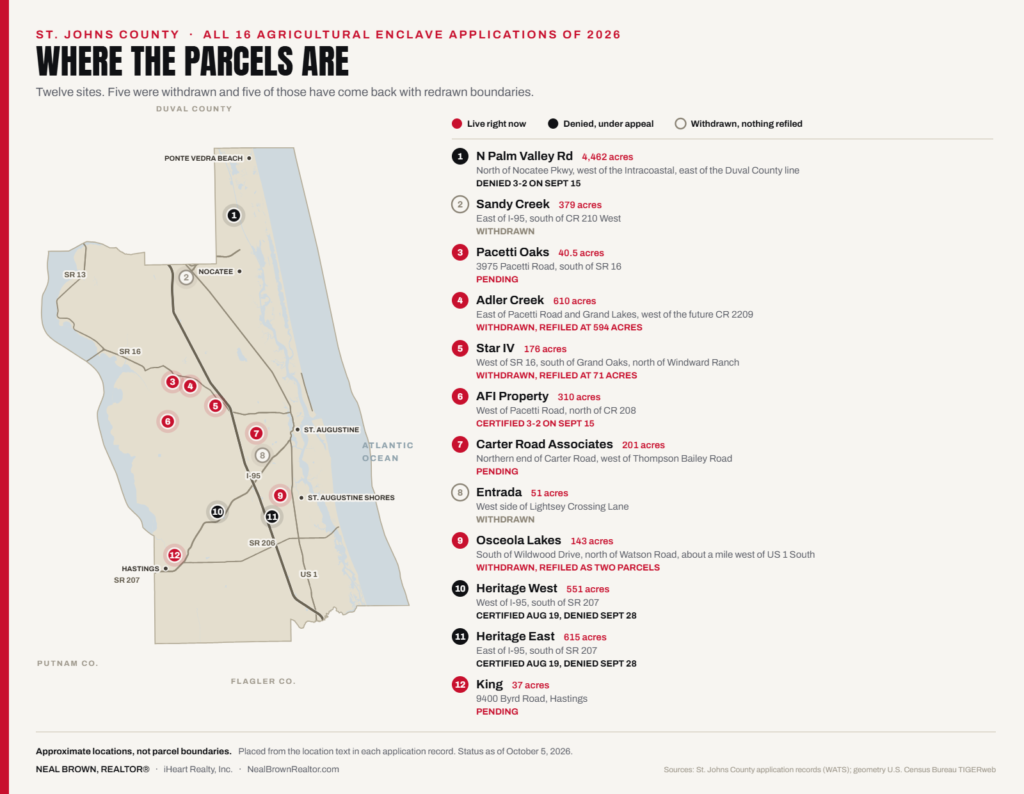
This is the part the news coverage tends to skip, and it is the only part most homeowners care about. The county has logged sixteen enclave applications this year across twelve pieces of ground. Here is every one of them, grouped by where it actually stands.
Denied by the commission, now headed for court
- N Palm Valley Rd, about 4,462 acres. North of Nocatee Pkwy, west of the Intracoastal, east of the Duval County line. Denied 3-2 on Sept 15.
- Heritage West, about 551 acres. West of I-95, south of SR 207. Certified Aug 19, denied Sept 28.
- Heritage East, about 615 acres. East of I-95, south of SR 207. Certified Aug 19, denied Sept 28.
Certified, and the certification still stands
- AFI Property, about 310 acres. West of Pacetti Road, north of CR 208. Certified 3-2 on Sept 15.
Withdrawn, then filed again with the lines moved
- Adler Creek, about 610 acres. East of Pacetti Road and Grand Lakes, west of the future CR 2209. Withdrawn, refiled at 594 acres.
- Star IV, about 176 acres. West of SR 16, south of Grand Oaks, north of Windward Ranch. Withdrawn, refiled at 71 acres.
- Osceola Lakes, about 143 acres. South of Wildwood Drive, north of Watson Road, about a mile west of US 1 South. Withdrawn, refiled as two parcels.
Filed and waiting, with no hearing yet
- Pacetti Oaks, about 40.5 acres. 3975 Pacetti Road, south of SR 16. Pending.
- Carter Road Associates, about 201 acres. Northern end of Carter Road, west of Thompson Bailey Road. Pending.
- King, about 37 acres. 9400 Byrd Road, Hastings. Pending.
Withdrawn and not refiled
- Sandy Creek, about 379 acres. East of I-95, south of CR 210 West. Withdrawn.
- Entrada, about 51 acres. West side of Lightsey Crossing Lane. Withdrawn.
Two things jump out of that list. The first is scale. North Palm Valley alone is 4,462 acres, which is more than all the others put together. The second is the pattern at the bottom of it. Five applicants pulled their own applications before any vote, and three of those five came straight back with the boundary redrawn and the acreage cut. Star IV went from 176 acres to 71. Osceola Lakes got split into a 103 acre north parcel and a 40 acre south parcel. That is not a loophole, it is just how the process works, but it does mean a withdrawal is rarely the end of anything.
What the County Commission has actually done so far
If you have been trying to follow this through headlines, it reads like chaos. In order, it makes more sense.
- August 19. Heritage East and Heritage West both certified on 3-2 votes. North Palm Valley continued to a later date.
- September 1. On North Palm Valley, a motion to deny failed 2-3 and a motion to certify also failed 2-3. No action taken, which under the new 90-day rule put the largest application in the county on a path to certify itself automatically at the end of the month.
- September 15. With the clock nearly out, North Palm Valley denied 3-2. The same meeting certified the AFI Property, 310 acres west of Pacetti Road and north of CR 208.
- September 23. The Heritage applicants filed a petition for a writ of prohibition, essentially asking a court to stop the county from revisiting their August approvals.
- September 28. Heritage East and Heritage West denied 3-2, reversing the August certifications.
Source: St. Johns County Board of County Commissioners regular meetings, August 19, September 1, September 15 and September 28, 2026.
Where it stands as of early October 2026
Of everything filed, exactly one certification is still standing, and that is the AFI Property. Three applications have been denied outright and are headed for a courtroom. Five were withdrawn by the applicants before a vote ever happened, and three of those five are already back in front of the county with the lines moved. Seven applications are sitting there with no hearing scheduled at all.
- The North Palm Valley applicants have said they intend to appeal. As of October 5 nothing had been reported as filed, and their 30-day window runs out around October 15.
- The Heritage certiorari window runs to roughly October 28. There has been no reported ruling on the writ of prohibition they filed on September 23, and the court clearly did not stop the September 28 hearing.
- The county has authorized outside counsel and is looking at an injunction, along with possible action in federal court.
- Nothing enclave related is on the October 6 commission agenda. October 20 is the next realistic date for one, and those agendas usually post about a week ahead.
- Commissioner Murphy has been gathering petitions aimed at the legislative session that opens in January 2027, with an eye toward changing or repealing the process before the 2028 sunset does it anyway.
So nothing is settled. If you are hoping for a clean answer about what is going to be built behind you, there is not one yet, and anybody who tells you otherwise is guessing.
What this does to your home value
I want to be straight with you here. There is no study and no reporting on what these applications are doing to property values in St. Johns County. Anyone quoting you a percentage made it up. What follows is my own read from showing and selling houses in these neighborhoods, and you should weigh it as exactly that.
Four things I believe based on how buyers actually behave:
- Buyers pay for certainty, not for empty land. The thing that makes a buyer hesitate is not knowing. A field with a pending application and no decision is harder to explain at a showing than a field with an approved plan, even if the approved plan is for 800 homes.
- In the short run, an active application near you adds a question to every showing. Not a dealbreaker. A question. And questions you can answer honestly tend to cost you less than questions you dodge.
- In the long run it depends entirely on what shows up. Rooftops that come with road capacity, a school and some retail have historically been fine for nearby resale here. Rooftops that come with none of that are a different story. Some of the strongest resale neighborhoods in this county sit next to things people once showed up in red shirts to fight.
- The most exposed homes are the ones whose whole pitch was the view. If you bought specifically for the pasture out the back window and that is what the listing photos lead with, you have more riding on this than a neighbor three streets in.
Worth noting too: your tax bill and your market value are two different conversations, and both of them are in motion this year. I wrote about the other one in your 2026 TRIM notice and what Amendment 3 changed.
What I would do if I lived near one of these
- Confirm you are actually near one. “North of Nocatee Parkway” covers a lot of ground. Pull the parcel on the county property appraiser site and look at the real boundary instead of the headline description. Plenty of people worrying about this are a mile and a half away from it.
- Read the staff report, not the comment thread. The county planning staff report tells you what was requested. The Facebook version tells you what people are afraid of. The gap between those two is usually enormous. The widely shared “26,772 units” number, for example, came out of public comment advocacy, not out of anything an applicant asked for.
- Get on the agenda notification list. These items move fast and the meaningful votes have all happened at regular commission meetings. Showing up beats finding out.
- If you are thinking about selling in the next twelve months, plan the conversation now. You are going to get asked about the field. Having the actual status and a printed map in the house is worth more than hoping nobody brings it up.
- If you are staying ten years, take a breath. Five of six applications were denied. The law sunsets in 2028. Whatever eventually gets built next to you will take years to permit and years more to come out of the ground.
Common questions about the St. Johns County agricultural enclave applications
Does certification mean houses are coming?
No. Certification settles a land use question. The owner still has to come back through site planning, wetlands and stormwater review, traffic concurrency and state and federal permitting, and still has to decide to actually build. Certified land has sat untouched for years in plenty of places.
Does a denial mean the land stays farmland forever?
No, and this is the part people most often get wrong. A denied enclave application just closes the shortcut. The owner can still apply for a comprehensive plan amendment and rezoning the normal way, nothing in this law takes that away. There is also nothing stopping an owner from pulling an application, redrawing the boundary and filing again, which is exactly what has already happened three times here. Star IV came back at 71 acres after withdrawing at 176. Osceola Lakes withdrew at 143 acres and came back as two separate parcels. Adler Creek withdrew at 610 and refiled at 594.
Can the county simply deny every application?
It can vote to deny, but the state law gives applicants a 30-day path into circuit court, and that is where several of these are heading now. Whether the denials hold up is a question for a judge, not for a commission.
What happens on January 1, 2028?
The 2026 process sunsets. New applications under it stop. Anything already certified or already in litigation does not evaporate because the window closed, which is a big part of why applicants are pushing so hard right now.
Will this hurt my home value?
Nobody has measured it, so I will not pretend to a number. My honest read is that uncertainty costs you more in the short term than the eventual development does in the long term, and that the outcome depends almost entirely on what infrastructure comes with whatever gets built.
Should I sell before anything gets built?
That depends on things that have nothing to do with the enclave law, like your timeline, your rate, your equity and where you are going next. Selling into a news cycle because of a vote that is already being appealed is usually a worse plan than selling when it suits your life. Happy to look at your specific situation if it helps.
How do I find out if my street is near one of these parcels?
Start with the county property appraiser map and the ENCERT case numbers listed above. If you would rather not wade through it, send me your address and I will pull the parcel boundaries and tell you plainly how close you are.
Want to know what this means for your street?
I have been tracking these applications since they were filed because my clients keep asking about them. If you are near one of these parcels and you want to know what it actually means for your house, whether that is a value question, a selling question or just a what-am-I-looking-at question, reach out. No pitch. I will pull the map and tell you what I see.
If you are weighing a move in the next year, my home selling page walks through how I price and market homes in St. Johns County, including the ones with a complicated story out the back window.
Neal Brown is a Realtor® with iHeart Realty, Inc., serving St. Augustine, St. Johns County, Jacksonville, Palatka and Green Cove Springs. This article is general information about a public land use process and is not legal, tax or land use planning advice. Nothing here is a prediction or guarantee about property values or development outcomes. For legal questions about a specific parcel, talk with a Florida land use attorney. Information current as of October 5, 2026. Application names, acreages, locations and filing status come from St. Johns County’s own land development application records. Vote counts and dates come from Board of County Commissioners agendas and minutes and from reporting by the Jacksonville Daily Record, St. Johns Citizen and The Florida Trib. The law itself is CS/CS/CS/SB 686 (2026), Chapter Law 2026-34.