
Over the last few weeks I’ve had the same question come up at open houses, on the phone, and in my own neighborhood: “If this property tax amendment passes, should I wait to sell? Should I sell now?”
Fair question. Amendment 3 is on the November 3, 2026 ballot, and it’s the biggest change to Florida homestead taxes in a long time. So I went straight to the source: the St. Johns County Property Appraiser and St. Johns County government.
Here is the short version. If you’re a St. Johns County homeowner thinking about selling, Amendment 3 is not a reason to wait. Your Save Our Homes savings and portability stay exactly the same whether it passes or not. If it does pass, the bigger exemption applies to your next Florida homestead too. The people it changes things for are buyers moving here from out of state, and for them one date matters a lot: December 31, 2026.
Quick note before we start: I’m not telling you how to vote. Both the Property Appraiser and the County say they don’t support or oppose the amendment, and I’m with them on that. My job is to help you make a smart move with your house either way.
Prefer to watch? I walk through all of this in about four minutes on my YouTube channel, St. Johns Living & Listings.
What is Amendment 3 on the Florida ballot?
According to the St. Johns County Property Appraiser, if voters approve it:
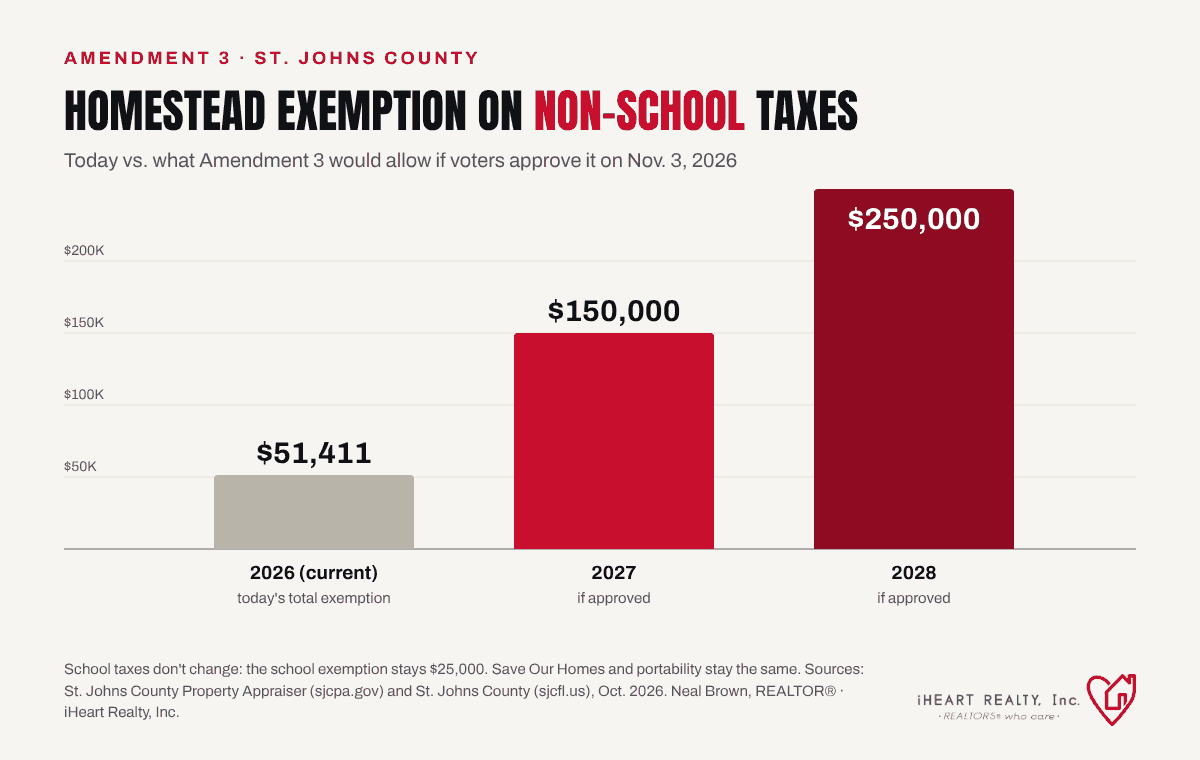
- Your homestead exemption goes up to $150,000 starting January 1, 2027, and to $250,000 starting January 1, 2028. The County says it would then adjust for inflation (CPI) each year starting in 2029.
- It only applies to non-school taxes. School taxes don’t change, and the school exemption stays at $25,000.
- Non-homestead properties (rentals, second homes, commercial) would see their yearly assessment cap drop from 10% to 5%.
- Save Our Homes and portability stay exactly the same. So do the existing exemptions for veterans, seniors, first responders, widows and widowers, and people with disabilities.
- Property taxes don’t go away. You’ll still get a bill.
It needs 60% of the vote to pass. If it does, it takes effect January 1, 2027. You’d first see it on your August 2027 TRIM notice and your November 2027 tax bill. The tax bill you get this November 1 isn’t affected.
How big is the homestead exemption in St. Johns County today?
For 2026, the full homestead exemption in St. Johns County is $51,411, per the Property Appraiser’s homestead page. The first $25,000 applies to all taxes, including school taxes. The other $26,411 applies only to non-school taxes.
Here’s what that looks like next to the Amendment 3 numbers.
How much would Amendment 3 lower my St. Johns County tax bill?
At the County’s Amendment 3 town hall on September 29, County Administrator Joy Andrews walked through a couple of examples, as reported by News4JAX:
- A homeowner paying about $3,400 now could pay about $2,700 in 2027.
- A homeowner paying about $3,500 now could pay about $2,100 in 2028.
That second example is about $1,400 a year, or roughly $117 a month. Real money.
But your number depends on your assessed value, your exemptions and your tax district, so don’t take those as your bill. You can look up your own parcel on the Property Appraiser’s website to see where you stand today.
Should I sell my house now or wait for the Amendment 3 vote?
This is the part I most want sellers to hear: your portability is safe.
A lot of folks who’ve owned their homes for years have big Save Our Homes savings built up, because the assessed value on a homestead can only rise 3% a year or the change in CPI, whichever is less. Picture two identical houses on the same street. One has been homesteaded since 2012 and the other just sold. The long-time owner’s assessed value can be far below market, and their tax bill shows it.
When you sell, you can carry those savings to your next Florida homestead. That’s portability. Amendment 3 doesn’t touch any of it. Per the Property Appraiser:
- You can port up to $500,000 in Save Our Homes savings.
- You have up to three tax years from the sale of your home to set up your new homestead.
- If you downsize to a home with a lower market value, the benefit is reduced proportionally.
- You can use portability as many times as you move.
And if the amendment passes, the bigger exemption applies to whatever home is your homestead. So if you’re a current Florida homeowner moving across town, from Nocatee to a smaller place in St. Augustine Shores, or from Jacksonville to the beaches, you’d get the higher exemption on the new place too.
In other words, you don’t need to wait for the vote to sell. Your tax benefits come with you either way.
One practical tip: when you buy your next home, file for homestead and portability by the deadline. It’s normally March 1, and it was March 2 this year because March 1 fell on a weekend. The Property Appraiser’s customer service line is (904) 827-5500 if you have questions about your situation.
Moving to Florida? Why December 31, 2026 matters under Amendment 3
Here’s the piece of Amendment 3 I don’t think many people have noticed yet, and it matters to sellers because it affects your buyer pool.
Under the amendment, people who become Florida residents on or after January 1, 2027 don’t get the full exemption right away. They’d start with a $50,000 exemption on non-school taxes and become eligible for the larger exemption beginning in their fifth year of homestead. People who are Florida residents by December 31, 2026 qualify for the higher amounts.
The important detail, per the Property Appraisers’ FAQs: it’s about when you become a Florida resident, not when you buy a house. Someone who moves here and establishes residency by December 31 would still qualify for the higher exemption when they buy later.
We get a lot of buyers relocating to St. Johns County from other states. If you’re one of them, or you’re helping a relative move down, this is worth a conversation with the Property Appraiser’s office now, before the year ends. My relocation questions page covers the other things people ask me before a move.
And if you’re a seller, it’s one more reason this fall could be a good time to have your home in front of relocating buyers who are trying to get settled. I’m not promising a rush of buyers here. It all depends on the vote and on each buyer’s plans. But it’s a real deadline, and buyers who know about it will be paying attention.
What does Amendment 3 mean for rental property and second homes?
The non-homestead cap dropping from 10% to 5% would slow how fast assessed values can rise on rentals and second homes. Keep in mind that under Florida law today, that cap resets when a non-homestead property sells, so a buyer starts over at market value.
I buy investment property in this market myself, so I look at this one from both sides. If you own a rental and you’re deciding between holding and selling, run the numbers with your CPA. I’m happy to pull what your property would likely sell for so you have the full picture.
What would Amendment 3 mean for St. Johns County services?
I think it’s fair to share both sides of the ledger. St. Johns County estimates about $426 million in property tax revenue for fiscal year 2027. Using state estimates, the County projects Amendment 3 would reduce that by:
- $68.3 million (16%) in 2028
- $136.1 million (32%) in 2029
- $191.6 million (45%) by 2032
Right now, about 31% of county property tax dollars go to the Sheriff’s Office and 27% to Fire Rescue, with roads, parks and libraries making up much of the rest. The County is clear that these estimates don’t automatically mean cuts to any department, since those decisions would go through the public budget process. You can see the full breakdown on the County’s Amendment 3 page.
Supporters point to real tax relief for homeowners. Opponents, including local governments and public safety groups, worry about how services get funded. That’s for you to weigh at the ballot box. Election details are on the St. Johns County Supervisor of Elections website. If growth and county budgets are on your mind, my post on the St. Johns County agricultural enclave fight covers the other big local issue this fall.
What I would do if I were selling this fall
It’s not the fun answer, but the vote doesn’t change the basics. Here’s how I’d approach it:
- Look up your current Save Our Homes savings. Pull your parcel on the Property Appraiser’s site and compare your assessed value to your market value. That gap is roughly what you could port.
- Get a real price, not an online estimate. What actually moves the needle on your sale is pricing it right, preparing it well, and getting it in front of the right buyers. My selling page walks through how I do that.
- Plan the next house before you list. Know which part of town you’re headed to and roughly what it costs. My neighborhood guides are a good place to start.
- Budget the next tax bill honestly. Portability helps, but your new home’s assessment starts over at market value, minus whatever savings you port. Don’t budget off the seller’s old bill.
- File homestead and portability on time after you close on the next place. Missing the deadline is the easiest way to lose the benefit.
- Don’t time your sale around the vote. Time it around your life, your next home, and the market in your neighborhood.
Frequently Asked Questions about Amendment 3
When is the vote on Amendment 3?
November 3, 2026. It needs 60% of the vote to pass, and if it does, it takes effect January 1, 2027.
Does Amendment 3 change Save Our Homes or portability?
No. The St. Johns County Property Appraiser says both stay unchanged. You can still port up to $500,000 in Save Our Homes savings to your next Florida homestead.
Would Amendment 3 lower my school taxes?
No. The amendment applies to non-school taxes only. The school exemption stays at $25,000.
When would I see a difference on my tax bill?
If it passes, on your August 2027 TRIM notice and November 2027 tax bill. The bill you get this November 1 isn’t affected.
Should I wait until after the vote to sell my house?
For most St. Johns County homeowners, no. Your Save Our Homes savings and portability come with you either way, and if it passes, the larger exemption applies to your next Florida homestead too.
I’m moving to Florida. Does the December 31 date matter to me?
If it passes, yes. People who become Florida residents by December 31, 2026 qualify for the higher exemption. People who become residents on or after January 1, 2027 start with a $50,000 non-school exemption and become eligible for the larger one in their fifth year.
Does Amendment 3 affect rental properties?
Rentals and second homes don’t get the homestead exemption, but their yearly assessment cap would drop from 10% to 5%. That cap still resets when the property sells.
Let’s look at your numbers, not the averages
Every example in this post is somebody else’s house. If you want to know what your home would sell for this fall and what your portability could look like on your next place, send me a note or text me at (904) 699-5412. I’ll pull your parcel, your likely sale price and the tax picture on the homes you’re considering, and walk you through it in plain English. I reply personally, usually the same day.
If the honest answer is “wait,” that’s what I’ll tell you. No pitch. You can read what past clients say on my testimonials page, and if any of these terms are new to you, my Real Estate Dictionary has plain-English videos on property tax, market value and more.
I’ve been in Jacksonville since 1990, when my family moved here from outside Chicago. I’m a Realtor® with iHeart Realty, Inc., and I buy investment property in this market myself, so I look at every move the way I’d look at my own.
Sources: St. Johns County Property Appraiser, Amendment 3; St. Johns County Property Appraiser, Homestead Exemption and Portability; St. Johns County, Proposed Property Tax Amendment 3; CS/HJR 1F bill text; Property Appraiser Amendment 3 FAQs. Information as of October 7, 2026. This is general information, not legal or tax advice. I’m a Realtor®, not a tax advisor or attorney, so please confirm your own situation with the Property Appraiser’s office or your tax professional.