
Almost every seller conversation I have in October lands on the same question: when is the best time to sell a house in St. Augustine, and should we just wait until spring?
It’s a fair question. Ask Google or ChatGPT and you’ll get the standard answer: spring is the best time to sell a house. More buyers are out, the weather is nice, everyone’s motivated.
That answer isn’t wrong. It’s just incomplete.
Spring is when the most buyers shop. It’s also when the most sellers list. Your house doesn’t compete against the calendar. It competes against the other homes for sale the week a buyer is looking, and in St. Johns County that field looks very different in December than it does in April.
So I pulled two years of MLS data for St. Johns County, which includes St. Augustine, and looked at what actually happens to listings in the fall, winter, and spring. Here’s what the numbers say, a few Florida-specific factors that national advice skips, and how I’d make the call if it were my house.
Here is the short version: fall and early winter bring fewer buyers, but far fewer competing listings. Spring brings the most of both. And in St. Johns County, the price you start at moves your bottom line more than the month you pick. If your house is ready and you know where you’re going next, there’s no reason to sit and wait for April.
Prefer to watch? I walk through all of this in about five minutes on my YouTube channel, St. Johns Living & Listings.
Table of Contents
Is fall a bad time to sell a house in St. Augustine?
No. In St. Johns County, fall and early winter bring fewer buyers than spring, but they also bring far fewer competing listings, and that tradeoff often favors a well-prepared seller.
Here’s what that looked like the last two years for residential listings in St. Johns County:
In December 2024, 429 new listings hit the market and 390 homes went under contract. In December 2025, it was 401 new listings and 380 contracts.
Compare that with spring. In April 2025, 1,096 new listings came on and 654 went under contract. In April 2026, it was 935 new listings and 718 contracts.
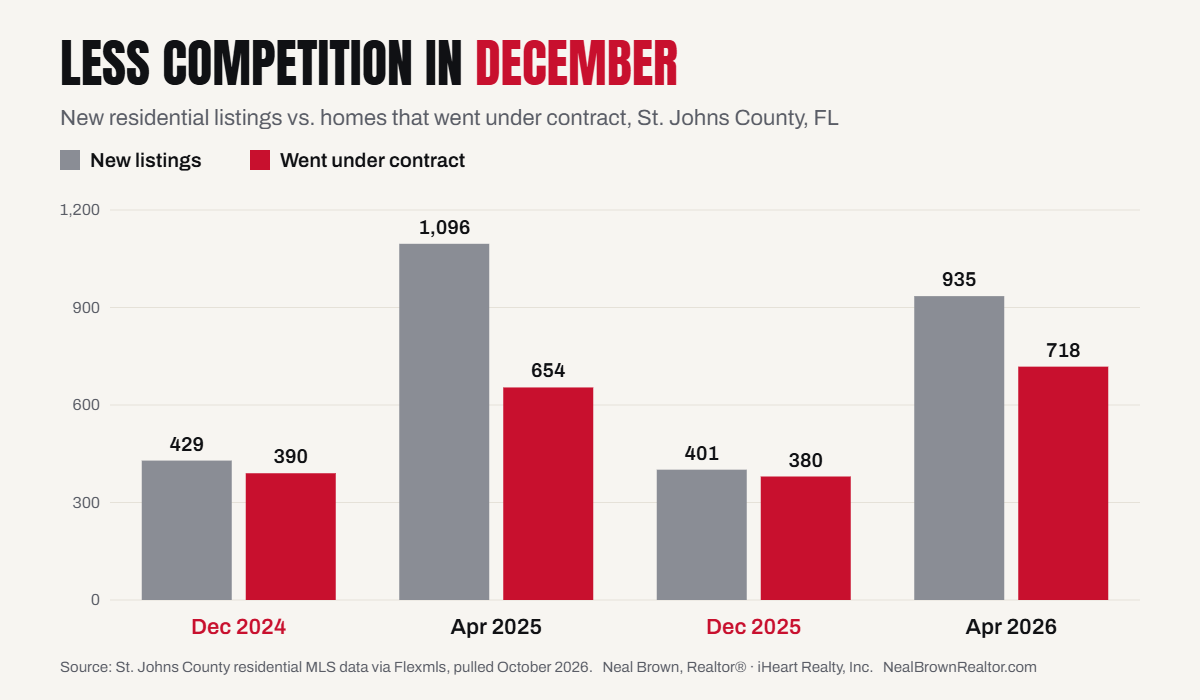
Put simply: in December, more than nine homes go under contract for every ten that come on the market. In April, it’s closer to six to eight.
April has more buyers in total. December has less competition for each buyer. A seller who lists in late fall isn’t fighting through a crowd to get noticed.
There’s another fall advantage right now. St. Johns County had 2,123 active residential listings in September 2026, down from 2,781 in September 2025. That’s about 24% fewer homes on the market than a year ago. Buyers this fall have fewer choices than they did a year ago.
The honest downside: winter listings take longer to sell
Homes that closed in winter spent more time on the market. Homes that closed from December 2025 through February 2026 averaged 83 to 94 days on market. Homes that closed from June through September 2026 averaged 63 to 72 days.
Keep in mind that days on market is measured at closing, so a home that closed in January was usually listed in October or November. The slower pace is real. If speed is your top priority and you’re flexible on timing, that matters.
But slower isn’t the same as cheaper, which brings us to the part most sellers miss.
Where do St. Augustine sellers actually lose money?
St. Augustine sellers lose the most money to price reductions, not to the month they list. The gap between a home’s original list price and what it finally sells for costs sellers far more than seasonal timing does.
From October 2025 through September 2026, homes in St. Johns County sold for 96.9% to 97.9% of their final list price every single month. That number barely moved with the seasons.
The sale price compared to the original list price tells a different story. That ranged from 92.7% to 95.6%.
That two-to-four-point gap is price cuts. On a home at the county’s September 2026 median sale price of $500,000, every point is roughly $5,000.
The widest gaps showed up in homes that closed in the fall and early winter. To me, that says a lot of those sellers started too high and spent the season chasing the market down. The month wasn’t the problem. The starting price was.
This is why I tell sellers that pricing right on day one does more for their bottom line than picking the “perfect” month. A well-priced home in November beats an overpriced home in April.
What does it cost to wait until spring to sell?
Waiting until spring costs you months of carrying costs, a more crowded field of competing listings, and no guarantee that spring prices will be higher.
Carrying costs add up quietly. Every month you own the house, you’re paying mortgage interest, property taxes, homeowners insurance, HOA dues if you have them, utilities, lawn care, and pool service if you have a pool. If you’ve already bought your next home or you’re paying rent somewhere else, you’re carrying two housing payments.
Then there’s the competition. Spring listings peaked in March through May in both 2025 and 2026. Your home will be one of many fresh listings, and buyers comparing ten similar homes tend to negotiate harder than buyers comparing three.
Waiting also assumes the market will be better in April. Nobody can promise that. The median sale price in St. Johns County was $495,000 in October 2025 and $500,000 in September 2026, which is close to flat. Sellers who wait should do it for a reason they control, not a price they’re hoping for.
Florida timing factors national advice ignores
Most “best time to sell” articles are written for markets with snow, school calendars, and nothing else. Selling in Northeast Florida comes with a few timing factors of its own.
Hurricane season ends November 30
Hurricane season runs June 1 through November 30. When a named storm threatens the area, insurance companies can pause writing new policies until it passes. If your buyer can’t get insurance bound, the closing can slip.
A contract written in December through May doesn’t carry that risk. It’s one less thing that can delay your closing.
The January 1 homestead date motivates some buyers
Florida’s homestead exemption gives some buyers a real reason to close before the new year. In St. Johns County, the home must be the owner’s primary residence on January 1 of the year they’re applying for, and the filing deadline is March 1.
A buyer who closes and moves in by December 31 can file for homestead for the coming tax year. A buyer who closes on January 2 waits another year. I see that deadline focus buyer motivation in December.
Selling and buying again in Florida? Portability matters
If you’re selling your Florida homestead and buying another one here, Florida’s Save Our Homes portability can carry part of your tax savings to the new home. Most Florida homestead owners can transfer their Save Our Homes benefit from the old homestead to the new one, up to a maximum of $500,000 under Florida Statutes section 193.155.
The timeline is generous. You have to establish the homestead exemption on the new home within three years of January 1 of the year you gave up the old homestead, not three years after the sale. Your listing date still affects which tax year everything lands in, so it’s worth mapping out before you pick a date.
How do I decide when to list my home?
Decide your listing date based on four things: where you’re going next, how ready your house is, what you’ll be competing against, and what each month of waiting costs you. The calendar comes after those.
These are the four questions I walk through with every seller.
1. Where are you going next, and when?
Your next move sets the real deadline. If you’re relocating for a job in January, waiting for spring doesn’t work. If you’re buying another home locally, the order of operations (sell first, buy first, or both at once) matters more than the season.
2. Is the house actually ready?
A house that needs a roof, fresh paint, or a pile of deferred repairs shouldn’t be rushed onto the market in November just to beat the holidays. If prep work pushes you into January anyway, plan to list in late January or February, before the spring wave crests in March and April.
3. What will you be competing against?
County numbers are a starting point, not an answer. What matters is the active and pending listings in your neighborhood and price range. A three-bedroom in a St. Augustine subdivision with two other listings is in a very different spot than one with eight.
4. What does a month of waiting cost you?
Add up your monthly carrying costs and multiply by the months you’d wait. Then compare that number to what you realistically expect to gain by waiting. Sometimes waiting wins. Often it doesn’t.
If the answers point to now, list now. If they point to spring, use the months to prepare, not just to wait.
How should I prepare if I list my house this fall?
If you list this fall, get the house photo-ready before Thanksgiving, price it against the homes you’ll actually compete with in December, and have your insurance paperwork ready before the first showing. Here’s how I’d handle it.
- Aim to be live by mid-November. That gives your listing a few weeks of full exposure before the holiday weeks slow showings down.
- Line up the insurance documents buyers will ask for. In Florida, a buyer’s insurance quote often depends on the roof’s age, a 4-point inspection on older homes, and a wind mitigation report. Having those ready can keep a buyer from stalling out while they shop for coverage.
- Price against the current competition, not summer comps. The homes on the market in December are your real comparison. A price that made sense in July may look stale next to them.
- Keep holiday decor light. Simple decor keeps your photos usable well into the new year if the home is still on the market in January.
- Stay open to holiday-week showings. Fewer buyers tour in late December, but the ones who do are usually serious. Turning them away for convenience can cost you the one buyer who was ready to write an offer.
None of this is complicated. It just takes a few weeks of lead time, which is why the decision about when to list matters more in October than it does in December.
Listing this fall vs. waiting for spring in St. Johns County
Neither season is automatically better. Each has a different set of tradeoffs, and the right choice depends on which ones matter most to you.
The table below lines up what the St. Johns County MLS data shows for residential homes over the last two years, plus the Florida-specific factors from above. Two notes on reading it. Days on market and sale-to-original-price figures are measured at closing, so they reflect homes that were listed a month or more earlier. And none of this is a promise about how your specific home will perform. It’s a picture of how the market has behaved, to help you weigh the tradeoffs instead of defaulting to “spring is best.”
| Factor | Listing in Fall or Early Winter | Waiting for Spring |
|---|---|---|
| Competing new listings | Lowest of the year: 401 in December 2025 | Highest of the year: 935 in April 2026 |
| Contracts per 10 new listings | More than 9 in December (2024 and 2025) | About 6 to 8 in April (2025 and 2026) |
| Average days on market | 83 to 94 days for homes closing December through February | 63 to 72 days for homes closing June through September |
| Sale price vs. original list price | 92.7% to 93.8% for homes closing October through January | 94.9% to 95.6% for homes closing April through September |
| Sale price vs. final list price | About 97% year-round | About 97% to 98% year-round |
| Storm and insurance risk | Hurricane season ends November 30 | Season resumes June 1 |
| Carrying costs | Stop sooner | Continue for several more months |
| Year-end buyer motivation | January 1 homestead date | None tied to the calendar |
Frequently asked questions
What is the best month to sell a house in St. Augustine, FL?
There isn’t one best month for every seller. Spring brings the most buyers, but it also brings the most competing listings, while December brings the fewest new listings of the year. In St. Johns County, the starting price has a bigger effect on what sellers net than the month they list.
Do houses sell in December in St. Johns County?
Yes. In December 2025, 380 homes went under contract in St. Johns County while only 401 new listings came on the market. Fewer buyers shop over the holidays, but the ones who do tend to be serious, and some are aiming to close before the January 1 homestead date.
Should I wait until spring to sell my house in Florida?
Wait only if you have a specific reason, like needed repairs or a move that’s already set for spring. Waiting adds months of carrying costs, puts you up against the year’s biggest wave of new listings, and doesn’t guarantee a higher price. Compare your monthly carrying costs to what you realistically expect to gain before deciding.
Does hurricane season affect selling a house in Florida?
It can. When a named storm threatens, insurers can temporarily stop writing new policies, which can delay a buyer’s closing. Hurricane season runs June 1 through November 30, so contracts written from December through May avoid that risk.
How long does it take to sell a house in St. Augustine?
Homes that closed in St. Johns County between October 2025 and September 2026 averaged 63 to 94 days on market, depending on the month, with the longest stretches for homes closing in winter. Add the time from contract to closing, which is often 30 to 45 days for a financed purchase. Pricing it right from day one is the biggest thing you control.
Can I list my house in the fall and still catch spring buyers?
Yes, but a home listed in November that’s still for sale in March carries all the days on market it has piled up. Spring buyers notice that, and it often leads to lower offers. If you list in the fall, price it to sell in the fall rather than treating spring as a backup plan.
Before you pick a date
I’ve lived in Northeast Florida since 1990, when my family moved to Jacksonville from outside Chicago. I’m a Realtor® with iHeart Realty, Inc., and I buy investment property in this market myself, so I look at every sale the way I’d look at my own.
If you’re weighing a fall listing against waiting for spring, make that decision with real numbers from your neighborhood, not a rule of thumb from a national website. Send me a note through my contact page and tell me your street and when you’d like to be moved. I’ll pull the active, pending, and recently sold homes around you, walk through the four questions above with you, and give you a straight answer on whether now or later makes more sense. If the honest answer is “wait,” that’s what I’ll tell you.
You can also start on my Sell page and grab my free seller guide, read what past clients say on my testimonials page, or text me at (904) 699-5412. I reply personally, usually the same day.
Neal Brown, Realtor® · iHeart Realty, Inc.
This article is general information about the St. Johns County housing market as of October 2026, based on MLS data pulled October 5, 2026. It is not legal or tax advice, and past market patterns don’t guarantee how any home will sell. For homestead and portability questions, check with the St. Johns County Property Appraiser or a tax professional.
Other resources
External authority resources
- St. Johns County Property Appraiser: Homestead Exemptions and Portability
- Florida Department of Revenue: Save Our Homes Assessment Limitation and Portability Transfer (PDF)
- Florida Department of Revenue: Property Tax Information for Homestead Exemption (PDF)