
Since the election, I’ve gotten the same text from neighbors here in 32092, past clients, and folks I’ve met at open houses: “Amendment 3 passed. So what does that mean if we sell next year?”
Fair question. Last month I wrote about what Amendment 3 would do if it passed. Now it has, so this post is about what actually changes for you as a St. Johns County seller in 2027.
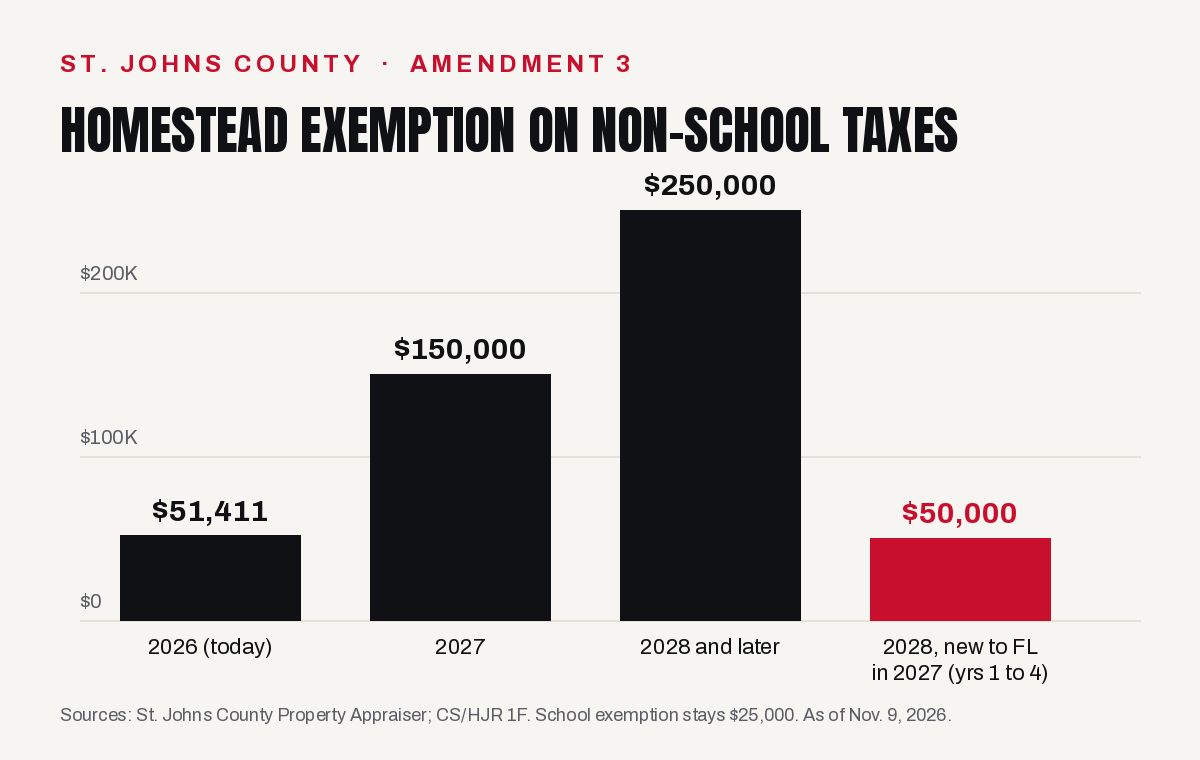
Here is the short version. Amendment 3 passed, and if you’re selling a St. Johns County home and buying again in Florida, it works in your favor: your Save Our Homes portability is unchanged, and your next homestead gets a $150,000 exemption on non-school taxes in 2027 and $250,000 in 2028. The part that changes your sale is the buyer pool. People who become Florida residents on or after January 1, 2027 start with a $50,000 exemption for their first four years, so on a typical 32092 home they’ll pay roughly $1,370 a year more in county taxes than a local buyer once the full exemption kicks in.
Quick note: I’m not here to argue whether Amendment 3 was a good idea. The vote is done. My job is to help you make a smart move with your house under the rules we have now.
Prefer to watch? I walk through all of this in about 5 minutes on my YouTube channel, St. Johns Living & Listings.
Did Amendment 3 pass in St. Johns County?
Yes. Statewide, Amendment 3 passed with about 62% of the vote in unofficial returns, above the 60% a constitutional amendment needs (Florida Court Rules summary). In St. Johns County, roughly 65% of voters said yes, according to Jacksonville Today’s election night numbers. The results are official once the state canvassing commission certifies them.
The St. Johns County Property Appraiser has already updated its Amendment 3 page to say the measure was approved and that its office will implement the changes.
What actually changes on January 1, 2027?
Here’s the official list, straight from the Property Appraiser:
- Homestead exemption on non-school taxes: $150,000 starting January 1, 2027, and $250,000 starting January 1, 2028, with inflation adjustments after that.
- School taxes: the school exemption stays at $25,000. School taxes still apply.
- Rentals, second homes and commercial property: the yearly cap on assessment increases drops from 10% to 5%.
- Save Our Homes and portability: unchanged. So are the existing exemptions for veterans, seniors, first responders, widows and widowers, and people with disabilities.
- New Florida residents: an extra residency requirement before they get the bigger exemption (more on that below).
Your 2026 tax bill, the one that came out this month, isn’t affected. You’ll first see Amendment 3 on your August 2027 TRIM notice and your November 2027 tax bill.
The Property Appraiser estimates homestead owners save about $700 in 2027 and about $1,400 in 2028. Your number depends on your assessed value and taxing district, so treat that as a ballpark.
I’m selling my St. Johns County home and buying again in Florida. Do I come out ahead?
In most cases, yes. Picture two tax breaks stacked on top of each other.
The first is portability. If you’ve had a homestead for a while, your assessed value is probably well below market value, because Save Our Homes caps yearly increases at 3% or inflation, whichever is less. When you sell, you can carry up to $500,000 of that savings to your next Florida homestead. Amendment 3 didn’t touch that. I walked through how it works in my post on Florida homestead portability.
The second is the bigger exemption. Because you were already a Florida resident before 2027, the new home gets the $150,000 non-school exemption in 2027 and $250,000 in 2028, as long as you qualify and file on time.
For years, the tax bill on the next house was one of the biggest reasons longtime owners in World Golf Village, St. Augustine Shores or Julington Creek stayed put. Amendment 3 shrinks that penalty. It doesn’t erase it, because your new home’s assessment still starts at market value minus whatever you port. But the jump is smaller than it used to be.
One timing detail that matters
Homestead is based on who owns and lives in the home on January 1. To claim the exemption for a given year, you generally need to own and occupy the new home on January 1 of that year and apply with the Property Appraiser by March 1. If you close on your next home in late December vs. early January, that can change which tax year your new exemption starts. Check your own dates with the Property Appraiser’s homestead page before you set a closing date.
How does Amendment 3 change who buys my house in 2027?
This is the part most sellers haven’t thought about yet.
Under Amendment 3, someone who becomes a permanent Florida resident on or after January 1, 2027 doesn’t get the full exemption right away. They get $25,000 against school taxes and $50,000 against everything else, and the full exemption starts in their fifth year of homestead. St. Johns County gets a lot of buyers moving down from other states, so this matters here.
Here’s what that looks like on the same 32092 house in 2028, once the full exemption is in place:
| Same 32092 home, 2028 | Buyer already living in Florida | Buyer who moved here in 2027 |
|---|---|---|
| Exemption on non-school taxes | $250,000 | $50,000 (years 1 to 4) |
| Exemption on school taxes | $25,000 | $25,000 |
| Difference in value taxed by the county | n/a | About $200,000 more |
| County tax difference at 6.8303 mills | n/a | About $1,366 more a year (about $114 a month) |
So a buyer relocating from out of state in 2027 is shopping with a tighter monthly budget than a buyer moving across town from Jacksonville, for the same house. About $114 a month won’t kill a deal on its own. Stacked on 7% rates and Florida insurance, it’s one more thing that buyer’s lender will count.
Two honest caveats. The Legislature still has to pass the rules for how the newcomer requirement is applied and proved. And the ballot summary said the rule applies only to the extent the U.S. Constitution allows, and some people have questioned whether it will hold up. I’ll update this post when those details are settled.
The December 31, 2026 line
The cutoff is about when someone becomes a Florida resident, not when they buy. A buyer who is relocating here and establishes Florida residency by December 31, 2026 should still qualify for the larger exemption when they buy later. From the day this post goes live, that’s about seven weeks away.
If you have relatives or friends moving down, have them talk to the Property Appraiser’s office now. I can’t tell anyone what counts as establishing residency. That’s a question for the Property Appraiser or an attorney. My relocation questions page covers the other things people ask me before a move.
What is the 32092 market doing right now?
Here’s how 32092 looked in October compared with a year ago. I live in this zip, so I watch these numbers closely.
| 32092, residential | Oct 2025 | Oct 2026 | What it means |
|---|---|---|---|
| Active listings | 623 | 475 | Down 24%. Less competition for your listing |
| Pending sales | 136 | 91 | Down 33%. Buyers are pickier with rates over 7% |
| Closed sales | 123 | 114 | Down 7% |
| Median sold price | $502,485 | $499,206 | Flat |
| Months of supply | 4.6 | 3.1 | Tighter than a year ago |
| Sale price vs. original list | 94.1% | 96.8% | Sellers who priced right kept more |
Prices are flat. Listings are down. Buyers are slower.
None of that is from Amendment 3 yet. It’s mostly the rate story I covered in my post on mortgage rates over 7%. Amendment 3 is the next thing layered on top, and we won’t see its effect in the numbers until 2027.
Will Amendment 3 change St. Johns County home prices?
Honest answer: nobody knows yet, and anyone who tells you a number is guessing.
Here’s how I think about it. Lower taxes on a homestead mean a lower monthly payment for buyers already in Florida, which helps them afford a bit more. Longtime owners may feel freer to sell and move up or down, which could bring more listings in 2027. And buyers moving here from other states face the four-year wait. Those pull in different directions. I’ll be watching the spring numbers, and I’ll tell you what I see.
What does Amendment 3 mean if I’m selling a rental or second home?
Rentals and second homes don’t get the homestead exemption. What they do get is a 5% cap on yearly assessment increases instead of 10%, starting in 2027. Keep in mind that the cap resets when a non-homestead property sells, so your buyer starts over at market value.
I own rental property in this market myself, so I look at this one from both sides. If you’re deciding whether to hold or sell, run it past your CPA, and I’ll pull what your property would likely sell for so you have the whole picture.
What will Amendment 3 mean for St. Johns County services?
It’s fair to look at both sides of the ledger. Using state estimates, St. Johns County projects property tax revenue drops of about $68.3 million (16%) in fiscal year 2028 and $136.1 million (32%) in 2029, against about $426 million expected in 2027. The County says those estimates don’t automatically mean cuts to any department. Those decisions go through the public budget process, and the County added $30 million in General Fund reserves this year to prepare.
If you care about roads, fire stations and parks out here, next summer’s budget hearings are the ones to watch.
What I would do if I were selling in St. Johns County in 2027
- Look up your Save Our Homes savings. Pull your parcel on the Property Appraiser’s site and compare assessed value to market value. That gap is roughly what you could port.
- Plan the next home and the closing dates together. The January 1 ownership date and the March 1 filing deadline decide when your new exemption starts.
- Get a real price, not an online estimate. With listings down 24% and pending sales down 33% in 32092, pricing it right on day one matters more than any tax rule. My selling page walks through how I do it.
- Don’t let buyers budget off your tax bill. Your bill reflects your homestead and your Save Our Homes cap. A buyer’s will be different, especially a buyer moving from out of state in 2027. Point them to the Property Appraiser’s Property Tax Estimator.
- Selling a rental? Talk to your CPA before you list, since the 5% cap resets at sale.
- Don’t time your sale around a tax rule. Time it around your life, your next home and the market on your street.
Frequently Asked Questions
Did Amendment 3 pass in St. Johns County?
Yes. It passed statewide with about 62% of the vote, above the 60% it needed, and roughly 65% of St. Johns County voters supported it in unofficial returns.
When will I see lower property taxes from Amendment 3?
On your August 2027 TRIM notice and November 2027 tax bill. The 2026 bill isn’t affected.
Does Amendment 3 change homestead portability?
No. Save Our Homes and portability are unchanged, so you can still port up to $500,000 of savings to your next Florida homestead.
If I sell and buy another home in St. Johns County, do I get the bigger exemption?
If you were already a Florida resident before 2027 and you qualify and file on time, yes: $150,000 on non-school taxes in 2027 and $250,000 in 2028.
What is the Amendment 3 five-year rule for new residents?
People who become permanent Florida residents on or after January 1, 2027 get a $50,000 non-school exemption until their fifth year of homestead, then the full amount. The Legislature still has to set the procedures.
Will Amendment 3 raise home prices in St. Johns County?
Too early to say. Lower taxes help in-state buyers, while the four-year wait affects buyers moving from other states, and there’s no 2027 sales data yet.
Does Amendment 3 help if I’m selling a rental property?
Not directly. Rentals get a 5% cap on yearly assessment increases instead of 10%, but that cap resets when the property sells.
Let’s look at your numbers, not the averages
Every number in this post is an example. Your situation depends on your parcel, your portability, your next home and your timing.
Send me a note through my contact page. I’ll pull your parcel, estimate what your home would sell for in today’s 32092 market, and show you what your tax picture could look like on the homes you’re considering. I reply personally, usually the same day. You can read what past clients say on my testimonials page, browse my neighborhood guides, or look up terms like assessed value in my Real Estate Dictionary. If you want the background, my October post covers what Amendment 3 proposed before the vote.
If the honest answer is “wait,” that’s what I’ll tell you. No pitch.
My family moved to Jacksonville from outside Chicago in 1990, and Northeast Florida has been home ever since. Today I live in St. Augustine, in 32092. I’m a Realtor® with iHeart Realty, Inc., a Florida Army National Guard veteran, and a Military Relocation Professional, and I buy investment property in this market myself, so I look at every move the way I’d look at my own.
Sources: St. Johns County Property Appraiser, Amendment 3; St. Johns County, Property Tax Amendment 3; CS/HJR 1F text; Florida Court Rules, Jacksonville Today, Jax Daily Record and News4JAX as linked above; Northeast Florida MLS via flexmls. Information as of November 9, 2026; election results unofficial until certified. This is general information, not legal or tax advice. I’m a Realtor®, not an attorney or tax advisor, so please confirm your situation with the Property Appraiser’s office, (904) 827-5500, or your tax professional.