
If you are looking into how to sell your house without a realtor in St. Augustine, you have probably already decided to try it, or you are close to it. This is written for that decision, not against it.
I am a Realtor®, so I have an obvious interest here and I am not going to pretend otherwise. But most of what follows is the same work I do on a listing, written out so you can do it without me. People sell their own homes in St. Johns County every month and some of them do it well. What separates the ones who do from the ones who lose money is almost never effort. It is knowing which five or six things actually decide the outcome.
Everything below is specific to Northeast Florida — our MLS, our disclosure law, our insurance problem, our contract. National for sale by owner advice will not tell you which multiple listing service covers your house or that your CDD assessment is a disclosure item. Those details are where private sales here go wrong.
For sale by owner in Florida: what the numbers actually say
You will hear that homes sold without a realtor sell for far less. Here is that statistic, and here is why the honest version is more complicated than either side usually admits.
In the National Association of Realtors® 2025 Profile of Home Buyers and Sellers, five percent of sellers sold without an agent — an all-time low. Homes sold without an agent had a median price of $360,000 against $425,000 for agent-assisted sales. That is roughly an eighteen percent gap and it gets quoted at people constantly.
It is also not a fair comparison, and I would rather tell you that than use it as a scare tactic. Those are two different sets of houses, not the same house sold twice. Sixty percent of private sellers in that survey already knew their buyer — family, a neighbor, a tenant — and forty percent did not actively market the property at all. Zillow’s own research on the price gap concluded it reflected location and home size rather than a discount, because private sales skew rural, smaller, and lower priced.
So a prepared for sale by owner seller in St. Johns County should not expect to lose eighteen percent. You also should not expect to lose nothing. The real risks are narrower and more specific, and they are what the rest of this is about.
Which MLS actually covers your house, and why it matters
This is the part almost nobody writing about Florida FSBO gets right, and it costs St. Johns County sellers real exposure.
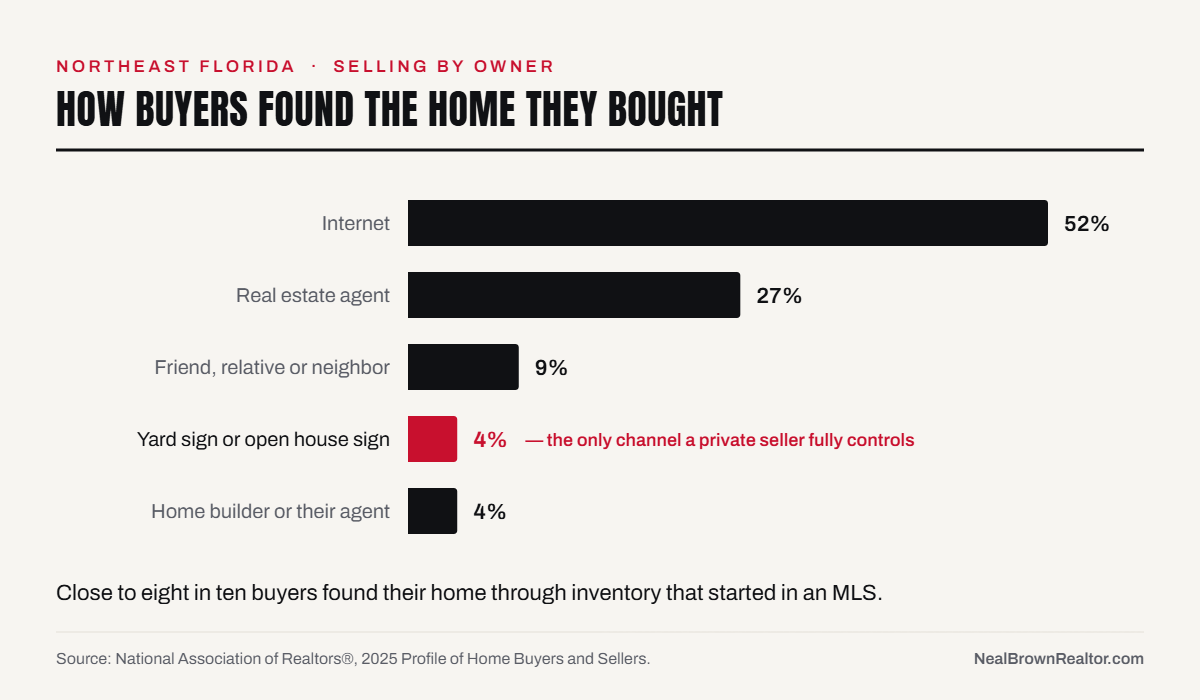
Fifty-two percent of buyers found the home they bought on the internet and twenty-seven percent found it through an agent. Read that carefully: nearly all of that internet traffic is portal inventory fed by the MLS, and the agent share is agents searching the MLS directly. Functionally, close to eight in ten buyers found their home through inventory that started in a multiple listing service. The yard sign channel — the one a private seller fully controls — is four percent.
Your sign is not the problem. It is just not the answer either.
If you buy a flat fee MLS entry, ask exactly one question before you pay: which MLS does this feed? Northeast Florida is served by realMLS, operated through the Northeast Florida Association of Realtors®, and St. Johns County also has the St. Augustine and St. Johns County Board of Realtors®. A listing entered into the wrong system, or into a distant board’s MLS because that is what a statewide vendor happens to use, can be invisible to the Duval-side buyer agents who sell a great deal of St. Johns County real estate. Vendors rarely volunteer this. Ask, and get the answer in writing.
What a flat fee entry does and does not buy
It buys you a listing under a licensed broker, syndication to the major portals, and an MLS number so buyer agents can find, schedule and write on your home. That is genuinely worth paying for.
It does not buy pricing analysis, photography, anyone answering the phone, showing coverage, buyer vetting, negotiation, contract drafting, deadline management, disclosure guidance, or help when the appraisal comes in low. Before you sign, read the agreement for three things: whose name and phone appear as the listing contact, how you make a price change and how long it takes, and what happens if you cancel.
How to price your home without a realtor: build your own comp set
You do not have MLS access. You do have the county property appraiser, and that is closer to a real comp search than most people realize.
Start at sjcpa.gov for St. Johns County. Duval is at paopropertysearch.coj.net, Clay at ccpao.com, Putnam at pa.putnam-fl.com. You can filter by sale date, price, subdivision, heated square footage, year built and pool.
Here is the field almost everyone misses. Property appraisers flag every sale as qualified or unqualified. Unqualified means it was not arm’s length — family transfers, estates, foreclosures, quitclaims. Filter those out or your comps are garbage. It is the same screen a licensed appraiser runs.
Your filter, in order: qualified sales only, closed in the last six months, same subdivision or one that genuinely competes, heated square footage within fifteen percent, year built within about ten years, and the same basic configuration on pool or no pool. Three to six good comps beat twenty loose ones.
One rule that sellers reverse constantly: adjust the comp, never your house. If the comp is better than yours, subtract from its sale price. If it is worse, add. Then compare your home against the adjusted numbers.
The concession blind spot
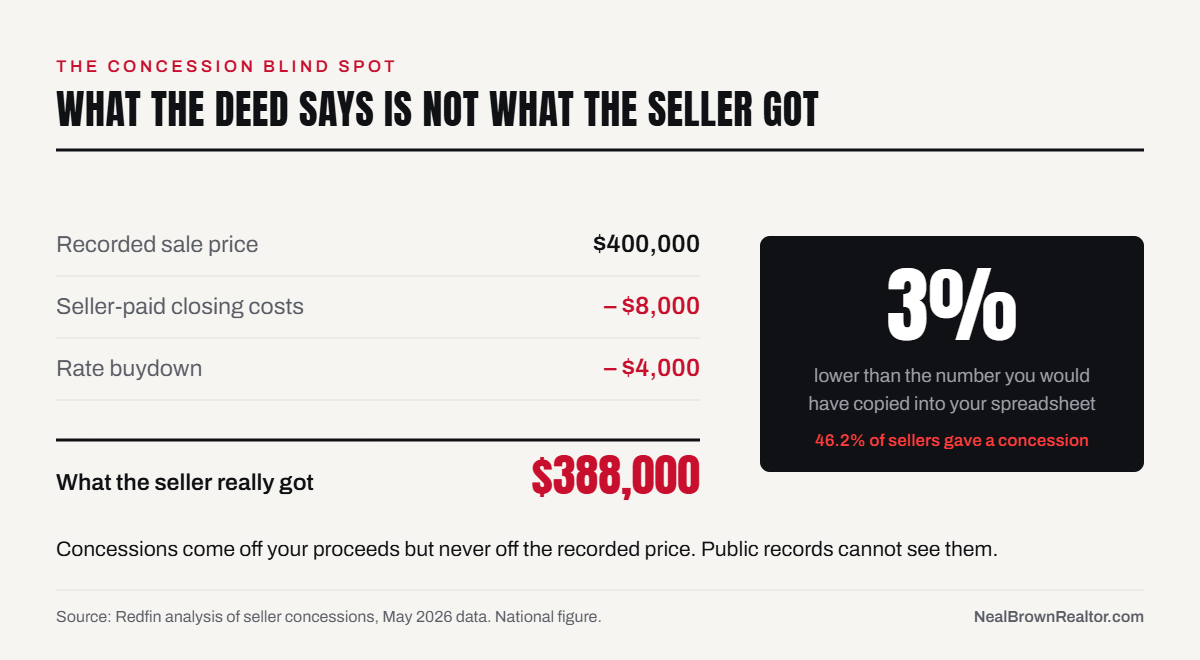
The deed says $400,000. The property appraiser says $400,000. What neither says is that the seller paid $12,000 toward the buyer’s closing costs and bought down their rate for two years.
Seller concessions come off your proceeds but not off the recorded price, and public records cannot see them. In May 2026, 46.2 percent of sellers nationally gave a concession, the highest share on record for that month. If close to half the sales in your neighborhood carry an invisible concession, then a comp set built from raw recorded prices is systematically high. Not wildly. A couple of percent — which is exactly enough to put you above the cluster, get no showings, and never understand why.
Assume one is coming and price with room for it, rather than discovering it across the table in week six. Ask any agent who shows your home what their buyer needed.
Three other ways sellers get price wrong
- Pricing off what the neighbors are asking. Active listings tell you what sellers hope for, not what anybody paid. The house down the street listed since March is not a comp, it is a warning.
- Pricing off what you need to net. The most common one, and completely understandable. You know your payoff and what the next house costs, so you work backwards. The market does not know any of that.
- Trusting an automated estimate. Zillow publishes its own accuracy figures, and for off-market homes the median error has run around seven percent. On a $400,000 home that means half of all estimates are off by more than $28,000 in one direction or the other. Worse, since 2019 the estimate factors in a home’s own list price once it goes on the market, so it drifts toward whatever you asked and then appears to confirm it — including when you were wrong. I wrote more about that in trusted agent versus tricky Zestimate.
What Florida makes you disclose
Selling without a realtor removes the person who normally hands you these forms. It does not remove a single one of the duties.
Under Johnson v. Davis, a 1985 Florida Supreme Court decision, a seller who knows facts that materially affect the value of the property and that a buyer would not readily see has to disclose them. It is a duty, not a form. And an “as is” contract does not waive it — Florida courts have said so directly.
There is a sequencing trap that catches private sellers. Once a first buyer’s inspector finds something, you now know about it. If that deal dies, you have to tell the next buyer. Sellers who quietly skip that step create liability that dwarfs whatever they saved.
The list, specific to here
- Flood, in writing, before the contract is signed. Since October 2024 Florida sellers must give a written flood disclosure at or before contract. It was expanded in October 2025 to cover any flooding that damaged the property during your ownership, not only insured losses, plus any assistance you received. Standing water from sustained rainfall counts, so this is broader than named storms.
- Property taxes. Florida requires a tax disclosure summary at or before contract, warning the buyer their bill will not match yours. Save Our Homes does not transfer and the assessment resets the year after the sale. This is the single biggest source of angry calls after closing — I explained the mechanics in this piece on TRIM notices and property taxes.
- CDD assessments. If you are in Nocatee, SilverLeaf, Shearwater, Durbin Crossing, RiverTown, or a World Golf Village district community, Florida law requires disclosure of the Community Development District assessment. Buyers here routinely discover it after they are under contract, and it kills deals. Almost no national FSBO guide mentions this and it may be the most common disclosure failure in St. Johns County.
- HOA. The disclosure summary goes to the buyer before they sign, and if it does not, they get a cancellation right. Order the estoppel early. Unpaid assessments follow the property.
- Radon, sinkhole, lead paint. The radon notice goes on a document signed at or before contract. If a sinkhole claim was made and paid, disclose it and whether the full proceeds went into the repair. Federal lead rules apply to anything built before 1978, which covers a great deal of Lincolnville and downtown St. Augustine.
- Permit history. Open or expired permits show up on the municipal lien search and to title underwriters. Unpermitted work is a classic known material fact. Find out now at the building department, not in week three.
Insurance and the roof, the local deal killer
In this market more deals die over insurance than over inspections. The buyer’s credit is fine, their income is fine, and then they cannot get a policy at a price they can carry.
On roof age, Florida Statutes section 627.7011(5) is the provision that matters. An insurer may not refuse to write or renew solely because of roof age when the roof is under fifteen years old. At fifteen or older, the insurer must let you have it inspected at your expense first, and may not refuse solely on age if that inspection shows five or more years of useful life left. Roof age runs from the last time the full surface was replaced to code, not from a partial repair. You will read online that a 2026 law changed this. It did not — those bills died in committee. I covered the detail in this post on Florida’s roof age law.
Citizens sets its own eligibility. Broadly, a shingle roof over twenty-five years or tile or metal over fifty needs documented remaining life or proof of replacement, and Citizens requires a four point inspection on homes over twenty years old.
The flood requirement almost nobody has priced in
Citizens policyholders with wind coverage are being phased into a flood insurance requirement by dwelling replacement cost. As of January 2026 that threshold reached $400,000, and it extends to all remaining policies in January 2027. Anything in a mapped flood zone is required regardless of value.
So a buyer landing at Citizens at that replacement cost now carries a flood premium they may not have budgeted. On Anastasia Island, in Vilano, in Davis Shores, that is not hypothetical. It surfaces late and it breaks financing contingencies.
Get ahead of it. Order the wind mitigation report and, on an older home, the four point, before you list. They cost little, they tell you what a buyer’s insurance agent is going to say about your house while you can still act on it, and a good wind mitigation report lowers the buyer’s premium, which you hand them as a selling point.
Buyer agents, and what they will ask you
This is the part of selling privately that changed most recently, and the part most sellers have backwards.
- Every buyer with an agent has already signed something. Since August 2024, an agent working with a buyer must have a written agreement with that buyer before touring a home, and it states what the agent gets paid. You are not a party to it and not bound by it. But the buyer standing in your driveway already owes their agent a fee.
- If you offer nothing, that fee comes out of the buyer’s pocket. On top of their down payment and closing costs, in cash, at the moment when cash is the thing they have least of. Many of those buyers will simply go look at a house where the seller is covering it. Offering nothing does not so much save you money as quietly narrow the pool of people who will come see the house at all.
- Whatever you decide, it is negotiable and it is not set by law. There is no standard rate and nobody can tell you there is. You can offer a percentage, a flat amount, or nothing. What you cannot do is advertise an offer of compensation inside the MLS, which is why a flat fee listing will not carry it. It gets communicated another way: in your own advertising, in conversation, or negotiated into the offer itself.
- Decide it before the phone rings. Work out what you will and will not do, in writing, before your first showing request. Deciding it on the doorstep with a buyer’s agent standing there is how sellers agree to things they did not intend.
The contract, and the clock
The standard Florida Realtors® and Florida Bar “AS IS” residential contract runs on deadlines, and when a blank is left empty it fills in a default. Nobody is watching those dates for you.
- Initial deposit: 3 days after the effective date
- Additional deposit: 10 days
- Inspection period: 15 days
- Loan approval period: 30 days
- Title evidence: at least 15 days before closing if the blank is left empty, but 5 days if paragraph 8(a) is checked — read which box is marked
- Survey: at least 5 days before closing, which the form fixes rather than leaving blank
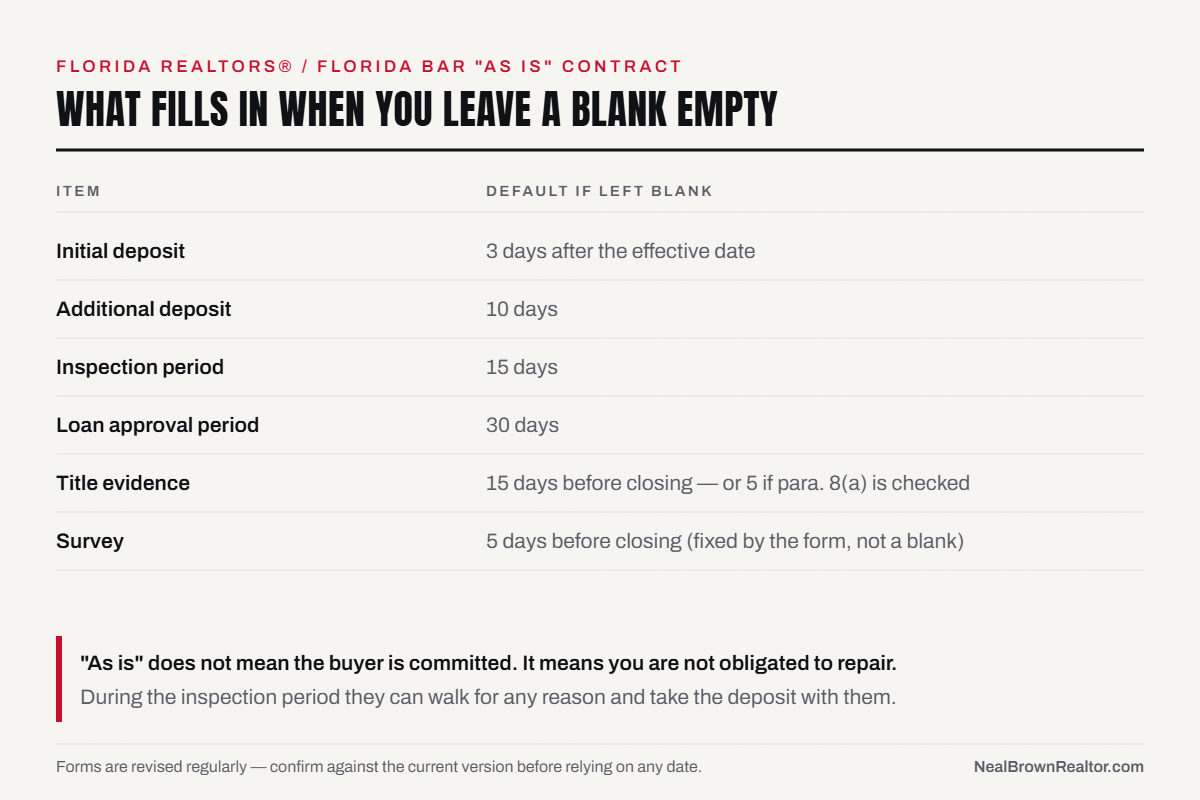
Forms are revised regularly. Confirm against the current version before you rely on any date.
The thing almost every private seller gets wrong: “as is” does not mean the buyer is committed. It means you are not obligated to repair anything. During the inspection period the buyer can terminate at their sole discretion, for any reason or none, and get the full deposit back. The first fifteen days are a free option for the buyer. Plan around that rather than being surprised by it.
You are not going to download this form. In practice a private seller gets the contract through an attorney or a title company, and that is the right way to do it anyway. Pay someone once to set it up correctly. It is the cheapest money you will spend in this whole process.
The line you must not cross
You can sign a contract in your own transaction. What you cannot do is advise your buyer. Explaining what a clause means for them, telling them how to take title, or recommending what a contingency does for them is practicing law without a license in Florida. Send them to their own attorney and say so in writing.
Deposit, title and closing
Do not hold the deposit yourself. Put the escrow with a title company or a Florida attorney. Title agencies holding escrow are regulated under Florida Statutes section 626.8473 — the funds sit in a separate insured account, they can only be used according to the closing instructions, and misuse carries criminal penalties.
Here is the part that matters most. When a broker holds escrow and the parties fight over it, there is a state process for resolving it. In a private sale there is no such process. No regulator, no escrow disbursement order, nobody to complain to. A disputed deposit becomes a lawsuit and nothing else. Handing the money to a neutral third party at the start is how you avoid ever finding that out.
A title company is not your advocate. They represent neither side. They cannot review your contract, explain a clause, tell you whether a termination was valid, or negotiate for you. Only an attorney can do that, and if you are selling privately you should have one on call. Ask two questions before you choose a closing office: is there an attorney in house, and can I hire them to represent me?
Two things that blindside private sellers
Wire fraud. Never act on wiring instructions that arrive by email without calling the title company on a number you looked up yourself. Not the number in the email. Real estate wire fraud is common here and the money is generally not recoverable.
FIRPTA. If the seller is not a US person for tax purposes, federal law makes the buyer responsible for withholding a percentage of the sale price. In a brokered deal somebody flags this early. In a private sale with an unrepresented buyer, often nobody does, and it surfaces at the closing table. Every seller should expect to sign a certification about this. If it might apply to you, talk to a CPA before you sign a contract.
Showings, safety and qualifying a buyer
In a national survey, twenty two percent of residential agents reported fearing for their personal safety on the job. Those are trained licensees who pre screen prospects and work through an office. You have none of that, and you are doing something an agent never does: advertising where your valuables are, who lives there, and when you are home. Then you sleep in the house afterwards.
That is not a reason to stop. It is a reason to have a protocol rather than improvising at the front door. Get full legal name, mobile and email every time. Call the number back. Require a pre approval or proof of funds before the showing. If they have an agent, verify the license free on the state search. Never show alone — two adults, no exceptions. Lock away medications, firearms, jewelry, mail and anything with an account number before every showing, and get children and pets out of the house.
On qualifying: a signed contract with a buyer who cannot close is worse than no contract at all, because it stops every other showing while it burns your best marketing weeks. The Consumer Financial Protection Bureau is blunt that prequalification and preapproval letters are not guaranteed loan offers. The conversation with the loan officer is the qualification. Put a line in your counteroffer authorizing you to speak with them, then ask whether they pulled credit and have income and asset documents in hand, whether the file has been through underwriting or only automated findings, what conditions are outstanding, and whether the borrower is approved at your price or a lower one.
This matters more here than most places. Jacksonville had the highest contract cancellation rate of any Florida metro reported in May 2026, at 17.9 percent of pending sales. Nearly one in five deals fell apart after both sides shook hands.
Your first fourteen days
Your listing is never more valuable than in its first two weeks. Every buyer already watching your neighborhood sees it at once, and that never happens again. Do not launch until you are ready.
Before you go live: comp set built and price set from it, net proceeds figured at two different prices, prep list finished, photos shot and ordered, wind mitigation and four point in hand, disclosures filled in, title company chosen, and a decision made about what you will offer a buyer’s agent.
Then go live early in the week rather than on a Friday night. Reply to every inquiry inside an hour if you can — research across 1.25 million sales leads found firms contacting a lead within an hour were far more likely to qualify it than those waiting longer. Batch your showings into two evenings and a Saturday block instead of being on call. Ask every visitor what they thought and write it down.
At day seven, check views against saves on the portals. Lots of views and almost no saves means your price is wrong. Almost no views means your lead photo or your price band is wrong. Check it at day seven, not day forty.
On photos: eighty one percent of buyers rated listing photos very useful in their online search, the highest of any feature. Shoot every room once, well. Twenty five to thirty five images is the practical range — under fifteen reads as though something is hidden, over forty is padding. Front elevation first, shot when the sun is on the face of the house.
When to stop selling FSBO, honestly
Every seller who ends up hiring someone waited longer than they wish they had. Not because they were stubborn, but because there was never an obvious day to stop. So here is one. Any of these four, and it is time to at least have a conversation:
- Thirty days, no offer. Not no good offer. No offer. The market has seen you and passed.
- Showings, but the same sentence three times. Your feedback has told you what is wrong and you have not acted on it.
- A deal fell apart and you are back on the market. This is the hardest place to sell from and where most people burn another sixty days.
- You have stopped answering the phone. When inquiries start feeling like a burden rather than an opportunity, the sale is already slipping.
Get the full playbook
Everything above is the overview. I wrote a twenty four page guide that goes through the whole thing in order — the comp worksheet, the net proceeds sheet you fill in at two prices, the full disclosure list, the showing safety protocol, the contract deadline calendar, and the four signals that tell you a private sale is not going to get there.
It is free, nothing in it is conditional on hiring me, and the worksheets are meant to be written on. Tell me where to send it.
Get the free FSBO playbook
24 pages: pricing worksheets, the full Florida disclosure list, the contract deadline calendar, and the honest checkpoint — tell me where to send it.
Common questions about selling a house without a realtor in St. Johns County
Do I need a real estate attorney to sell my house myself in Florida?
Florida does not require an attorney at closing the way some states do — a title company can close the file. But selling privately is exactly the situation where you want one. A title company represents neither side and cannot review your contract, explain a clause, or tell you whether a buyer’s termination was valid. Paying an attorney once to prepare the contract and be available for questions is the cheapest insurance in the process.
What paperwork do I need to sell a house by owner in Florida?
At minimum: the purchase contract (usually the Florida Realtors/Florida Bar “AS IS” residential contract), a written flood disclosure, a property tax disclosure summary, the radon notice, an HOA or condo disclosure summary with the estoppel if applicable, a CDD disclosure if you are in a district community, lead paint disclosure for homes built before 1978, and the deed and closing documents your title company or attorney prepares. A private seller normally gets the contract through their attorney or title company rather than downloading one.
Do I have to pay a buyer’s agent commission if I sell by owner?
No. It is fully negotiable and not set by law, and there is no standard rate. But since August 2024 every buyer working with an agent has already signed an agreement obligating them to pay that agent. If you offer nothing, that fee comes out of the buyer’s pocket in cash on top of their down payment, and many of those buyers will look at homes where the seller is covering it instead. Decide what you will offer before your first showing request, and get it in writing before the showing rather than after the offer.
Do I have to disclose CDD fees when I sell in Nocatee or SilverLeaf?
Yes. If your home is in a Community Development District, the annual assessment on your tax bill is material and Florida law requires it be disclosed. This is one of the most common disclosure failures in St. Johns County, because buyers routinely discover the assessment after they are already under contract and it kills the deal at the worst possible moment.
Which MLS covers St. Johns County?
Northeast Florida is served by realMLS through the Northeast Florida Association of Realtors, and St. Johns County also has the St. Augustine and St. Johns County Board of Realtors. If you are buying a flat fee MLS entry, ask which system your listing actually feeds and get the answer in writing. A listing entered into a distant board’s MLS can be effectively invisible to the buyer agents who sell the most homes in your area.
Does an “as is” contract mean the buyer cannot back out?
No, and this is the single most common misunderstanding. “As is” means you are not obligated to make repairs. It does not commit the buyer. During the inspection period — fifteen days if the blank is left empty on the standard form — the buyer can terminate at their sole discretion, for any reason or none, and get their full deposit back.
Who holds the earnest money deposit in a for sale by owner transaction?
A title company or a Florida attorney should, never you. Title agencies holding escrow are regulated under Florida Statutes 626.8473, with the funds in a separate insured account. More importantly, when a broker holds escrow there is a state process for resolving a dispute. In a private sale there is no such process — a disputed deposit becomes a lawsuit and nothing else.
Do I have to disclose problems if I am selling as is?
Yes. Under Johnson v. Davis, a Florida seller who knows facts that materially affect the property’s value and that a buyer would not readily see must disclose them, and Florida courts have held that an “as is” contract does not waive that duty. There is a trap here too: once a buyer’s inspector finds something, you now know about it, and if that deal falls through you have to tell the next buyer.
How much does it cost to sell a house without a realtor in Florida?
You still pay documentary stamp tax on the deed at $0.70 per $100 of price, the owner’s title policy (customarily the seller here, and negotiable), title and settlement fees, prorated taxes, any HOA or condo estoppel fee, and a municipal lien search. On top of that come your own costs: photography, a flat fee MLS entry, an attorney or title company for documents, pre listing inspections, prep, and carrying costs while it sits. Whatever you offer a buyer’s agent and any concession you give also come off your proceeds.
Is selling my house myself worth it in St. Augustine?
It can be, and it depends almost entirely on whether you already have a buyer. Sixty percent of private sellers nationally already knew their buyer. If you have a neighbor, a relative or a tenant lined up, hiring anyone may be a waste of your money and I will tell you so. If you need to find a buyer in the open market, you are taking on pricing, exposure, vetting, disclosure and deadline management yourself, and the pricing and timing pieces are where money actually leaves.
If you want a second opinion
You do not have to be ready to give up on selling it yourself to talk to me. Plenty of the conversations I have with owners never turn into a listing, and that is fine.
If you want a second opinion on your price, I will build you the same comparable sales analysis I would build for a client and walk you through it. No charge and nothing attached to it. Worst case you find out you were right.
Texting is the fastest way to reach me at (904) 699-5412. Call if you would rather. Either way it is me, and I reply personally, usually the same day. You can also send me a message here.
I am a Realtor®, not an attorney, a lender, a tax advisor or an insurance agent. This is general information for Northeast Florida homeowners to help you prepare, not legal, tax or insurance advice, and it is not an offer of representation. Laws, forms, insurance requirements and market data change. Broker compensation is negotiable and is not set by law.
Sources: National Association of Realtors®, 2025 Profile of Home Buyers and Sellers. Zillow research on for sale by owner listings. Redfin seller concession and contract cancellation data, May 2026. Florida Statutes sections 689.302, 689.261, 627.7011, 627.715 and 626.8473. Citizens Property Insurance inspection and flood requirements. Consumer Financial Protection Bureau guidance on prequalification and preapproval.
Neal Brown, Realtor® · iHeart Realty, Inc. · License #SL3413240 · (904) 699-5412 · Serving St. Augustine, Jacksonville, Palatka and Green Cove Springs · Equal Housing Opportunity